
You set a goal. You worked toward it. And somehow, you're still spinning your wheels.
Here's a question most business owners never ask: What if the problem isn't your effort, it's the goal itself?
What if your goal is too small to inspire you to actually take action?
It sounds backward. Most advice tells you to be realistic. Set achievable targets. Don't bite off more than you can chew.
But small goals create small energy. And small energy rarely moves the needle.

The Problem with "Realistic" Goals
You've heard it a thousand times: set SMART goals. Specific, measurable, achievable, relevant, time-bound.
And yeah, there's value in that framework. But here's what nobody tells you.
Achievable goals often aren't exciting.
They're safe. They're easy to justify. And they're really easy to ignore when things get busy.
Think about it. When was the last time you got fired up about hitting a 3% growth target? Or motivated your team by saying, "Let's aim for slightly better than last year"?
You didn't. Because nobody gets out of bed for slightly better.
Big Goals Create Big Energy
Here's what I've seen work time and time again with business owners.
When you set a goal that actually excites you, something big enough to feel a little scary, your brain shifts gears.
Suddenly, you're not thinking about incremental tweaks. You're thinking about what needs to fundamentally change to make that goal possible.
Big goals force you to think differently.
They make you ask better questions:
- What systems need to be in place?
- Who do I need on my team?
- What am I doing now that I need to stop?
- What skills do I need to develop?
Small goals let you stay comfortable. Big goals demand transformation.
And transformation is where real growth happens.
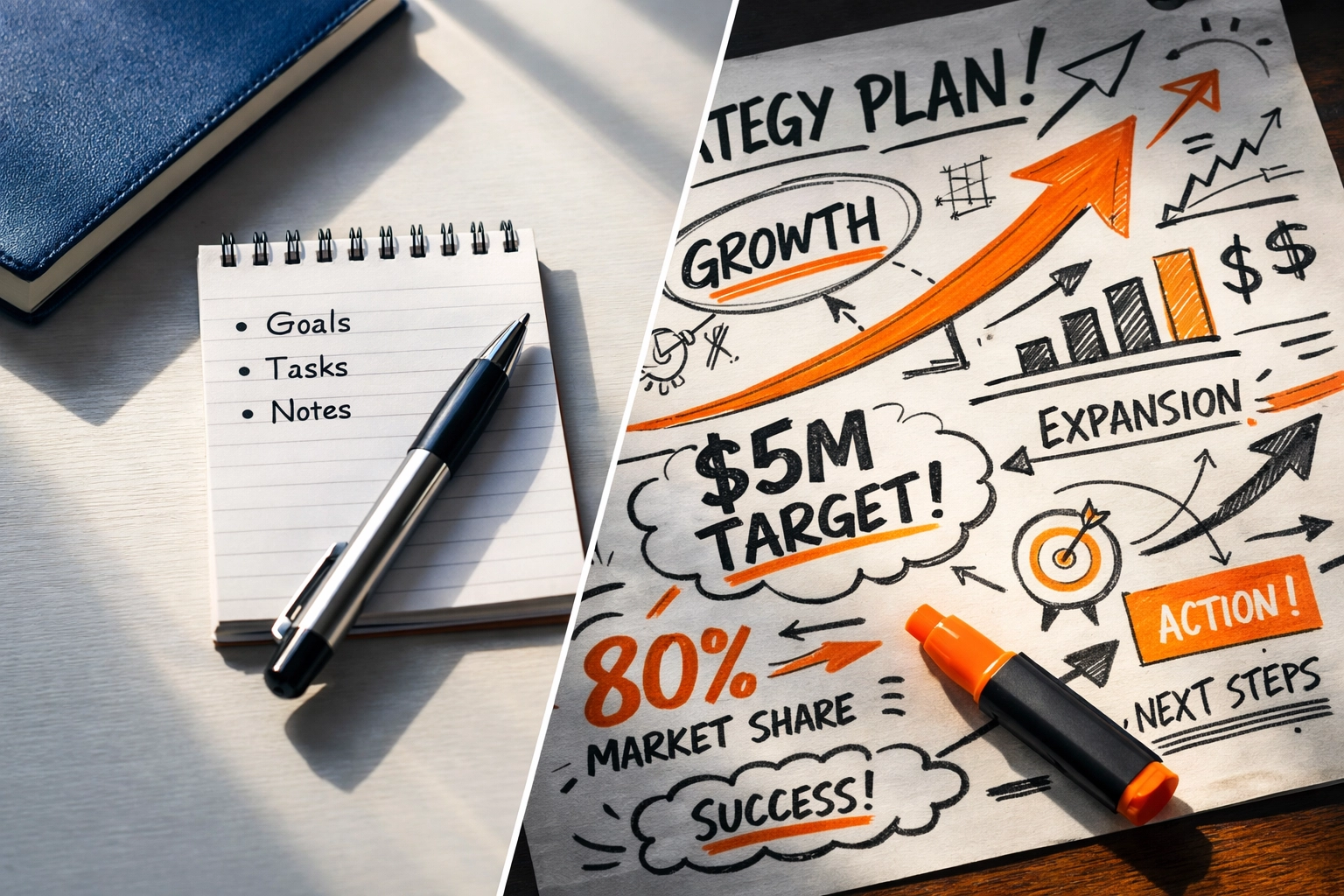
Why Small Goals Keep You Stuck
Let me give you a real example.
I worked with a business owner who set a goal to increase revenue by $50K over the next year.
Reasonable, right? Achievable. Safe.
But here's what happened. Nothing changed.
He kept doing the same things. Same marketing. Same sales process. Same team structure.
Because $50K didn't require him to change anything. He could hit that target by just working a little harder or getting a little lucky.
The goal was too small to force a breakthrough.
When we reset his goal to $500K in new revenue, everything shifted.
Suddenly, he needed a sales team. He needed better systems. He needed to stop doing $20-an-hour work and start focusing on strategy.
The bigger goal forced better decisions. And those decisions drove real action.
What Big Goals Actually Do
Big goals don't just motivate you, they restructure how you operate.
Here's what happens when you set a goal that actually inspires you:
You become more intentional with your time.
When you're working toward something significant, every hour matters. You stop wasting time on low-value tasks because you can't afford to.
You build the systems you've been avoiding.
You finally hire that assistant. You document your processes. You delegate the work you've been clutching onto for years.
You become more disciplined.
Big goals demand consistency. You can't coast your way to a 10X result. So you show up differently, every single day.
You start thinking like the person who's already achieved the goal.
This is the real shift. When you pursue something ambitious, you have to grow into the version of yourself who can achieve it.
And that growth? That's the point.

The Team Amplification Effect
Here's something most owners miss: big goals don't just energize you, they energize your team.
Your team knows when you're playing small. They feel it.
When you set a goal that's big enough to matter, your team leans in. They want to be part of something meaningful.
People don't get excited about maintaining the status quo.
They get excited about building something bigger. About being part of a win that actually feels like a win.
If you're struggling to get your team engaged, look at your goals. Are they big enough to inspire action?
Or are they just… fine?
How to Set Goals That Actually Drive Action
So how do you do this without setting yourself up for failure?
Start by asking yourself: What would I pursue if I knew I couldn't fail?
Not "what's realistic." Not "what feels safe."
What would genuinely excite you?
Then work backward. What would need to be true for that goal to happen?
- What resources would you need?
- What skills would you need to develop?
- What would you need to stop doing?
- Who would you need to become?
Write it down. Make it specific.
Instead of "grow the business," say "hit $5M in revenue by end of 2027."
Instead of "improve margins," say "increase net profit to 25% within 18 months."
Give yourself a target that makes your heart beat a little faster.
Then break it into milestones. You don't need to know every step. You just need to know the next one.
And then take it.

When You Need an Outside Perspective
Here's the thing about big goals: they require you to see yourself and your business differently.
And that's hard to do alone.
You can't read the label from inside the bottle.
Sometimes, the most valuable thing you can do is work with someone who can see what you can't: someone who can help you identify the goals worth chasing and the path to get there.
That's where coaching comes in.
Not to tell you what to do. But to help you see what's possible. To push you past the "realistic" goals that keep you stuck. To hold you accountable when the work gets hard.
Because big goals aren't just about what you achieve. They're about who you become in the process.
And that's the transformation that changes everything.
Your Move
So here's the question to sit with this week:
Are your goals big enough to drive real action?
If you're stuck, frustrated, or watching your team coast, your goals might be the problem.
Dream bigger. Set a target that scares you a little. Then build the plan to get there.
You'll be surprised how much energy shows up when you give yourself something worth chasing.

Ready to Set Bigger Goals?
If you're ready to stop playing small and start building something that actually excites you, let's talk.
At Vision Fox, we help business owners clarify their vision, set meaningful goals, and build the strategies to achieve them. Whether you're preparing for an exit or building for growth, we'll help you see what's possible: and create the roadmap to get there.
Reach out for a consultation today and let's turn that vision into action.
FAQ
What if I set a big goal and don't hit it?
Then you still accomplished more than you would have with a small goal. The point isn't perfection: it's progress. Big goals push you to grow, even if the timeline shifts.
How do I know if a goal is too big?
A good goal should feel 70% possible and 30% "I have no idea how I'll do this." If it feels 100% achievable, it's probably too small.
What if my team thinks I'm being unrealistic?
Share the vision. Help them see the why behind the goal. When people understand the bigger picture, they're more likely to buy in. And if they still resist, you might have the wrong team for where you're headed.
Can I set big goals and still be strategic?
Absolutely. Big goals require even more strategy, not less. You need clear milestones, smart systems, and disciplined execution. The goal is ambitious; the path is intentional.